
Smoke coming back into the room when you light your stove is more than an annoyance. It can leave soot on furnishings, make the room unpleasant to use and, in some cases, indicate a safety issue with the chimney or ventilation. The best chimney cowls for downdraught problems can make a real difference, but only when the cowl is matched to the cause of the problem.
A cowl is not a universal cure. Fitting the wrong one can restrict the flue, make sweeping more difficult or leave the original fault untouched. Before spending money on a new chimney pot fitting, it pays to understand what the wind, chimney and appliance are doing.
What causes a chimney downdraught?
A chimney should draw combustion gases upwards and safely away from the property. Downdraught happens when air pressure around the chimney terminal pushes air, smoke or fumes down the flue instead. You may notice smoke spilling from an open fire, a wood burner that is hard to light, a smell of smoke after the appliance is out, or a fire that behaves well on calm days but poorly in certain wind directions.
Wind is often blamed, and it is frequently involved, but it is not always the whole story. Homes in exposed positions, valleys, near taller buildings or beneath mature trees can experience turbulent airflow around the chimney stack. A chimney that is too short for the roof layout may sit in a pressure zone rather than clear air.
Other common causes include a cold flue, a partially blocked chimney, an unsuitable flue size, poor ventilation in a tightly sealed house, and extractor fans competing for air. Bird nests, debris and heavy soot deposits can also reduce the available flue area. This is why a chimney sweep and inspection should come before choosing a cowl.
The best chimney cowls for downdraught problems
There is no single best cowl for every Leicestershire home. The right choice depends on the type of appliance, chimney pot, flue liner and the local wind conditions. A competent assessment should look at the whole system rather than simply fitting the most elaborate-looking terminal.
Anti-downdraught cowls
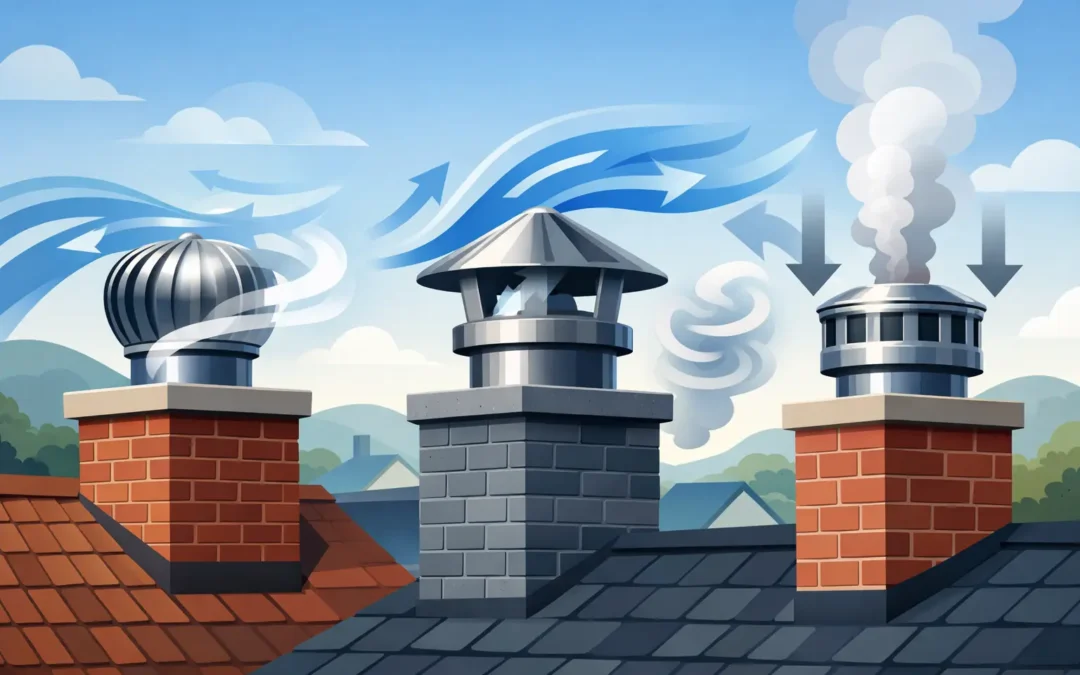
An anti-downdraught cowl is usually the first option considered for an open fire, stove or boiler flue affected by wind-driven blowback. These cowls are shaped to shield the flue opening and direct passing wind around it, helping maintain an upward pull.
They are a sensible choice where the chimney otherwise draws well but fails in gusty weather or when the wind comes from one particular direction. They are not designed to compensate for a blocked flue, serious height issue or poor combustion. Quality and correct fitting matter, as a loose, corroded or poorly sized cowl creates a problem of its own.
Rotating chimney cowls
Rotating cowls turn with the wind so that their opening faces away from it. Their purpose is to reduce the pressure that forces air down the chimney. They can be effective on exposed properties where wind direction changes regularly and a fixed anti-downdraught design cannot offer enough protection.
The trade-off is moving parts. A rotating cowl needs to be well made, securely fixed and checked as part of routine maintenance. Soot, corrosion and weathering can affect its movement over time. It must also be suitable for the appliance and flue temperature, particularly where a wood-burning or multi-fuel stove is used.
Static anti-wind cowls
Static anti-wind cowls have no moving parts but use a shaped hood, louvres or openings to break up wind pressure around the terminal. They are generally straightforward, durable and suitable for many domestic solid-fuel chimneys. For a property with an occasional downdraught rather than severe exposure, this may be the practical answer.
Their simpler construction can make them a good long-term option, but the design still needs to allow sufficient flue gas discharge and access for sweeping. A cowl that looks protective but restricts the outlet is not a safe upgrade.
Bird guard cowls with anti-downdraught features
Where birds have nested in the chimney, a guarded cowl may be needed as well as protection from wind. Combination cowls can prevent birds entering while also helping to reduce downdraught. This can be useful after a nest removal, particularly before the nesting season begins.
The mesh or guard must be appropriate for solid fuel. Fine mesh can clog with soot or tar and is not suitable in every situation. A chimney serving a stove needs a terminal arrangement that can be swept and maintained properly, not one that becomes a collection point for debris.
When a taller chimney or flue extension is the better fix
A cowl cannot always overcome poor chimney position. If the top of the stack is below the roof ridge, close to a neighbouring building, or caught in the disturbed air caused by an extension or tall trees, increasing the effective height may be more useful than changing the terminal alone.
This needs careful planning. The stack must remain stable, the extension must suit the flue system and the completed installation must meet the relevant requirements. Adding height can improve draw, but it also exposes the terminal to stronger winds, so the cowl and fixings need to be selected accordingly.
For twin-wall flues, termination height and position are especially important. A stove installation should be planned so the flue has the best possible chance of drawing correctly from day one, rather than relying on a cowl to solve an avoidable layout problem later.
Check the basics before fitting a chimney cowl
A downdraught report should start with the appliance and chimney in use. If smoke enters the room only when lighting the stove, the flue may simply be cold. Warming the flue with a small kindling fire or a firelighter before adding larger logs can establish an initial draw. Burning wet wood, overloading the firebox or closing air controls too early can also lead to smoke problems that no cowl will cure.
If the issue occurs after fitting new doors, windows or insulation, the house may not have enough replacement air. Solid-fuel appliances need a reliable air supply. Kitchen and bathroom extractors can pull air down a chimney, particularly in modern, airtight homes. Testing the stove with extractors off and a window briefly open can help identify whether negative pressure is involved.
The chimney itself should be swept and checked for blockages, liner faults, loose debris and damaged masonry. A CCTV chimney inspection is useful where the cause is unclear, as it can reveal restrictions or defects that cannot be seen from the fireplace. The chimney pot, flaunching and stack should also be sound before anything new is fitted at height.
Choosing the right cowl for your appliance
Open fires, wood burners, multi-fuel stoves, gas appliances and disused chimneys do not all need the same type of cowl. A terminal suitable for one fuel may be unsuitable or unsafe for another. Solid-fuel appliances produce hot gases, soot and, where fuel is damp or the stove is slumbered, deposits that demand a cowl designed for that service.
Size is equally important. The cowl must match the chimney pot or liner connection without reducing the effective flue area. It should be installed securely enough to withstand local weather, while allowing a sweep to clean the full flue. A good cowl is not just about stopping wind – it should support safe operation and sensible maintenance for years to come.
It is also worth being cautious about cheap, one-size-fits-all products. They may not be rated for the temperature of the appliance, may corrode early or may be difficult to remove for sweeping. The lowest purchase price can soon look less attractive if the cowl needs replacing or causes recurring smoke issues.
A practical way to solve persistent downdraught
If downdraught is happening regularly, record when it occurs. Note the wind direction, whether the fire is newly lit or established, whether extractor fans are on, and if the problem affects one appliance or several. This information helps separate a wind-terminal problem from a ventilation or flue fault.
A professional chimney sweep can then make sure the flue is clear and assess the terminal from ground level and at roof level where safe to do so. If more investigation is needed, a camera inspection can show whether the liner is correctly fitted and free from obstructions. Only then can the most suitable cowl, extension or ventilation measure be recommended.
At Thurnby Chimney Sweeps, we take that practical approach rather than fitting a cowl and hoping for the best. A properly diagnosed chimney gives you the best chance of a stove or fire that lights cleanly, draws well and keeps smoke where it belongs – safely up the flue.