
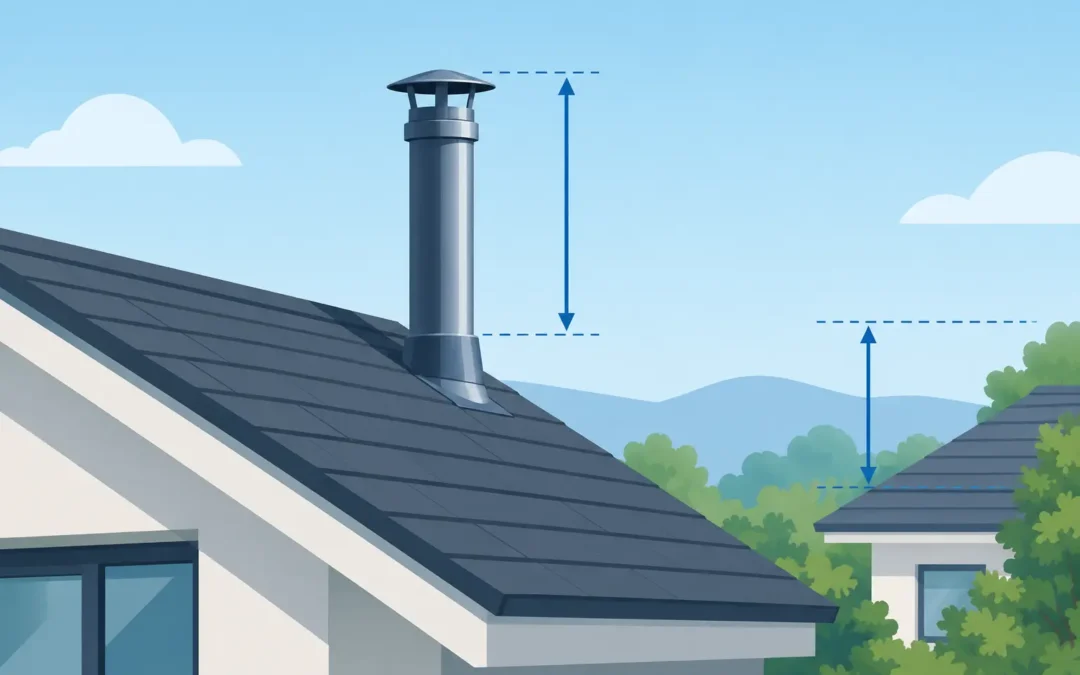
A flue can be perfectly sound inside the property and still cause trouble if its terminal finishes in the wrong place. Smoke spilling back towards a roof, poor stove draw and repeated downdraught are often linked to terminal position rather than the appliance itself. This guide to flue terminal heights explains what homeowners need to know before fitting, altering or investigating a solid fuel flue.
The key point is simple: a terminal must release combustion gases safely into clear air. That means it needs suitable height above the roof, enough separation from nearby structures and a position that works with the shape of the building. There is no single measurement that suits every house in Leicestershire.
Why flue terminal height matters
A wood-burning or multi-fuel stove relies on its flue to create draw. Warm gases rise through the system and pull fresh combustion air into the appliance. If the terminal is too low, tucked behind a ridge or close to a taller neighbouring roof, wind can interfere with that process.
The result may be smoke entering the room when the stove door is opened, a fire that is difficult to light, staining on the outside of the property, or fumes being blown towards windows and neighbouring homes. A poor terminal position can also make the flue more prone to condensation and tar deposits, particularly where the appliance is being run slowly.
Correct height is therefore about more than meeting a rule on paper. It helps the stove burn properly, reduces nuisance smoke and supports safe, reliable operation.
The main rules behind flue terminal heights
For solid fuel and wood-burning appliances, terminal positions are generally assessed against Building Regulations guidance, particularly Approved Document J, alongside the flue manufacturer’s installation instructions. A HETAS-registered installer will consider both. Manufacturer requirements matter because different twin wall flue systems, stoves and chimney arrangements may have specific conditions.
On a pitched roof, a terminal that is close to the ridge will usually need to finish at least 600mm above it. This is a common arrangement because the ridge is normally the clearest point for gases to disperse.
Where the terminal is further down the roof slope, the calculation changes. It will generally need to be at least 1 metre above the roof surface and at least 2.3 metres horizontally away from it. On a flat roof, a terminal is normally required to extend at least 1 metre above the roof surface.
These figures are useful starting points, not a reason to measure once and order a flue kit. Roof pitches, extensions, dormers, parapets and neighbouring buildings can all affect the required position. The terminal must also be placed so that fumes do not create a problem for doors, windows, ventilation openings or nearby properties.
A chimney stack is not automatically high enough
Many existing chimney stacks were built for open fires or older heating arrangements. A new stove liner may improve the chimney internally, but it does not automatically mean the pot is at the right height for the new appliance.
If a property has had a loft conversion, rear extension, new roofline or a taller neighbouring building, the original terminal position may now sit in a turbulent area. This is one reason a proper survey is worthwhile before a stove installation or a significant flue alteration.
Nearby buildings can change the answer
The roof on your own house is only part of the picture. A terminal can be affected by an attached neighbour’s ridge, a two-storey extension, a garage with a high roof, or even a close boundary wall. Wind flows over and around these structures, creating high-pressure and low-pressure zones that can push smoke back down the flue.
This is especially relevant for semi-detached and terraced homes, where roof heights can change from one property to the next. A terminal that clears your ridge may still be poorly positioned beside a taller adjoining roof.
For detached homes, outbuildings and trees can also have an effect, although they are assessed differently from a permanent neighbouring building. Mature trees move with the wind and may grow over time, so a sensible installer considers likely future clearance as well as the view on the day of the survey.
Twin wall flues need careful planning
External twin wall flues are often chosen where there is no usable chimney or where a new stove is being installed in an extension, conservatory or garden room. They can be an excellent solution, but they are not simply a pipe fixed to an outside wall.
The route needs to allow for the flue’s clearance from combustible materials, secure wall brackets, suitable support and safe weathering where it passes through the roof. Its terminal height must then be assessed in relation to the whole roof, not just the wall it rises beside.
A flue run that stops just above the eaves may look neat, but it is often vulnerable to downdraught and may not meet the required clearances. Taking the flue above the ridge can add cost and visual impact, yet it may be the more dependable option. The right choice depends on the property, the appliance and the surrounding roofscape.
When a taller terminal is not the whole fix
It is tempting to assume that adding another length of flue will cure smoke problems. Sometimes it does. Extra height can improve draw where a terminal is marginal or caught in roof turbulence.
However, a taller flue also needs proper support and may be exposed to stronger wind loading. It can make an installation more noticeable from the street and may be subject to planning considerations in some circumstances, particularly on listed buildings or in conservation areas. More height without checking the underlying cause can leave you with an expensive alteration that does not solve the problem.
Before changing a terminal, the rest of the system should be checked. Common causes of poor performance include a blocked flue, an unsuitable flue diameter, unsealed joints, a cold oversized chimney, inadequate air supply, damp fuel or incorrect stove operation. A CCTV chimney inspection can be useful where the route or condition of an existing flue is uncertain.
Cowls, rain caps and anti-downdraught terminals
A suitable cowl can protect against rain, discourage birds from nesting and, in some situations, help reduce downdraught. It is not a universal cure. The wrong cowl can restrict flow, collect soot or make sweeping more difficult.
Any terminal fitting should be suitable for solid fuel use and compatible with the appliance and flue system. It must also allow the flue to be swept properly. Decorative chimney pots, improvised mesh and general-purpose rain caps are not always appropriate for a stove flue.
If birds have nested in a chimney, the flue should be inspected and cleared before the appliance is used. Fitting a bird guard afterwards may be sensible, but only if it is the correct type and is maintained. Soot and debris can build up around guards, so regular sweeping remains essential.
What a professional survey should cover
A proper flue survey looks beyond a tape measure held against the roof. The installer should assess the appliance location, the proposed route, roof pitch, ridge height, nearby structures and access for future sweeping and maintenance. They should also check whether the existing chimney is sound enough to line or whether an insulated twin wall system is the safer route.
For a new solid fuel installation, the work must be notified through the correct route. Using a competent, appropriately registered installer provides a clear record that the installation has been assessed and completed to the required standard. Keep any certificate and appliance paperwork with your house documents, as they may be needed for insurance, a future sale or servicing.
At Thurnby Chimney Sweeps, we see many smoke and draw issues where the answer is not simply a new cowl or a quick extension. A careful inspection gives you a clearer answer and avoids spending money on the wrong remedy.
When to ask for help
Arrange a professional check if smoke blows down the chimney in windy weather, the stove struggles despite dry fuel and correct lighting, a new extension has changed the roofline, or you are considering a new stove and flue. You should also seek advice if you can smell fumes outdoors around upper-floor windows or if staining is appearing near the terminal.
A flue terminal is a small part of the system, but it has a major effect on how safely and comfortably your stove performs. Getting the height and position right at the start is usually far easier than correcting a troublesome installation after the first cold spell.