
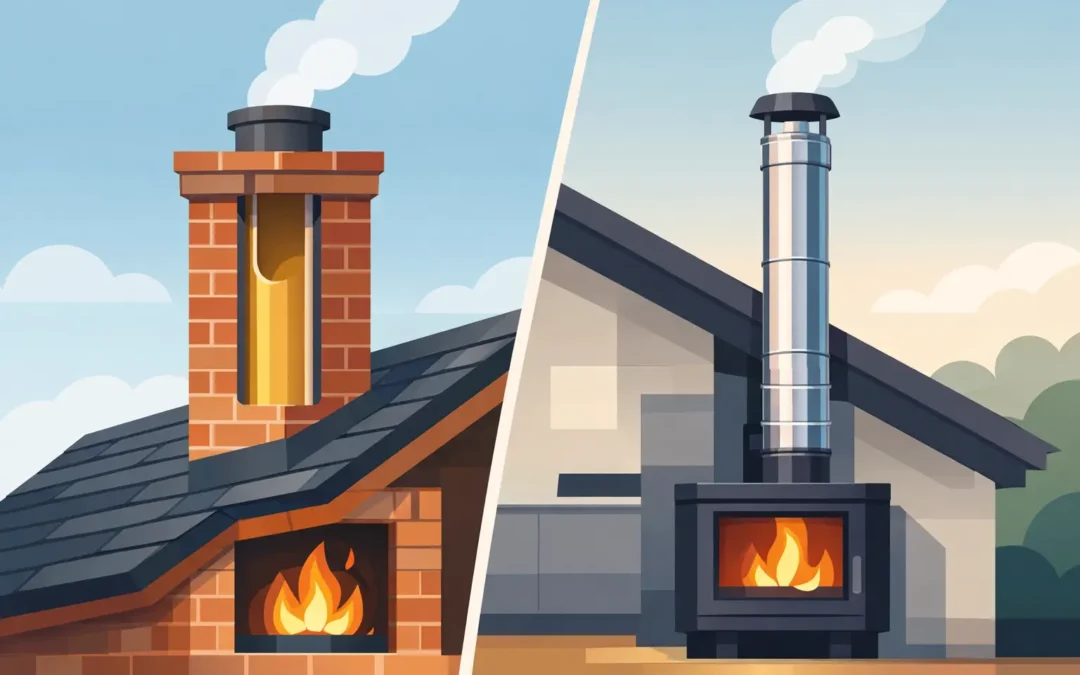
If you’re weighing up a chimney liner vs twin wall flue, you’re usually at the point of fitting a stove, replacing an unsafe flue, or trying to make sense of conflicting advice. The short version is simple: a chimney liner goes inside an existing chimney, while a twin wall flue is a complete insulated flue system used where there is no suitable chimney. The right choice depends on your property, your appliance, and whether the existing chimney is actually fit for purpose.
A lot of homeowners assume one is “better” than the other. In practice, they do different jobs. Choosing properly matters because the flue is not just a pipe for smoke. It affects draw, safety, appliance performance and compliance with current regulations.
Chimney liner vs twin wall flue – what is the difference?
A chimney liner is installed inside a masonry chimney. In most domestic stove installations, this is usually a flexible stainless steel liner dropped down the existing chimney stack and connected to the stove below. Its job is to create a correctly sized, continuous passage for fumes and to protect the chimney structure from heat, condensates and soot deposits.
A twin wall flue is a factory-made insulated flue system, normally stainless steel, built from interlocking sections. It is used when there is no existing chimney, or where the chimney route is unsuitable. Because it is insulated, it helps keep flue gases warmer as they travel upwards, which supports a better draw and reduces condensation.
So the basic distinction is this: if you already have a sound chimney breast and stack, a liner may be the answer. If you do not have a usable chimney at all, a twin wall system is often the practical route.
When a chimney liner makes sense
If your home already has a chimney, lining it is often the neatest and most cost-effective solution. Older chimneys can be oversized for modern stoves, damaged internally, or simply too rough and cold to work efficiently without a liner. Even if the chimney has carried smoke for years, that does not automatically mean it is suitable for a new stove.
A correctly specified liner helps the stove perform as it should. The flue gases stay hotter, the draw is more reliable, and the risk of tar and condensate causing trouble inside the chimney is reduced. It can also make sweeping and maintenance more straightforward.
That said, not every chimney can just be lined and forgotten about. The stack and pot still need to be in good condition, the route must be suitable, and the terminal arrangement at the top must be correct. If a chimney is badly damaged, heavily offset, damp ridden or structurally unsound, the answer may not be as simple as dropping a liner in.
Typical situations where lining is preferred
A liner is usually the first option where there is an existing masonry chimney serving a fireplace or stove recess. It suits many period homes, semis and detached properties where the chimney breast is already part of the house layout. It also tends to keep the finished look more traditional, because most of the flue system is hidden inside the chimney rather than visible on an outside wall or through rooms.
When a twin wall flue is the better option
Twin wall flue systems are commonly used in homes without a chimney, such as newer builds, extensions, garden rooms and some renovated properties where the original chimney has been removed. They can run internally through floors and out through the roof, or externally up an outside wall, depending on the layout.
This gives a lot more flexibility, but it also means the design matters. The route, number of bends, support brackets, roof penetration and distance from combustibles all need to be planned properly. A badly designed twin wall system can lead to poor draw, staining, smoke issues or an awkward appearance.
Twin wall is also useful when an existing chimney is in the wrong place for the intended stove position. Rather than forcing the appliance into a less practical room layout, a new insulated flue route may provide a cleaner solution.
Twin wall is not a shortcut
Some people assume twin wall is the easy option because it avoids the old chimney. Sometimes it is straightforward, but it is not a bodge and it should not be treated as one. It still needs to meet regulations, be correctly supported, and be installed with the right clearances. The visible nature of many twin wall systems means poor workmanship stands out straight away.
Cost, disruption and appearance
For many households, the real question behind chimney liner vs twin wall flue is cost. In broad terms, lining an existing usable chimney is often cheaper than installing a full twin wall system. There is less material involved, and the chimney itself provides the route.
Twin wall generally costs more because you are creating the whole flue system from scratch. More components are needed, and there can be additional labour depending on whether the flue runs through ceilings, loft spaces, roofs or external walls.
Disruption varies too. A liner can still involve opening up a fireplace, fitting closure plates, altering the chamber and carrying out checks on the stack. A twin wall installation may involve core drilling, boxing in, roof work or external brackets. Neither option is entirely mess-free, but a good installer should explain the likely process clearly before work begins.
Appearance matters as well. Some homeowners prefer the hidden look of a lined chimney. Others are perfectly happy with a neatly run twin wall system, particularly in modern homes where there is no chimney breast to work around. The best answer is often the one that balances safety, budget and how you want the room and exterior to look.
Performance and safety
Both systems can work very well when correctly designed and installed. Neither is automatically safer simply because of the name. Safety comes from suitability, proper fitting and ongoing maintenance.
A liner that is the wrong grade, damaged during installation or connected to a poor chimney setup can cause just as many problems as a badly planned twin wall system. Equally, a twin wall flue with too many bends or the wrong termination point may struggle to draw properly.
This is where site-specific advice matters. Stove output, appliance type, chimney height, flue diameter and the layout of the property all affect performance. There is no one-size-fits-all answer, which is why honest installers will say “it depends” rather than pushing a standard package.
Common mistakes homeowners make
One of the biggest mistakes is assuming an old chimney is automatically ready for a stove. Open fires and closed appliances behave differently. A stove usually needs a correctly sized flue system, not just an empty shaft above it.
Another mistake is focusing only on the appliance price and treating the flue as an afterthought. In reality, the flue is a major part of the installation. If it is wrong, the stove will never perform properly no matter how good the appliance is.
People also sometimes compare quotes without checking what is actually included. The grade of liner, the specification of twin wall components, the terminal, register plate, access for sweeping and any remedial chimney work all matter. A cheap quote can become expensive if corners have been cut.
Which option is right for your home?
If you have a sound existing chimney in the right place, a liner is often the sensible route. It usually keeps costs down, preserves the traditional look of the property and makes use of what is already there.
If you do not have a chimney, or the existing one is unsuitable, a twin wall flue is often the right answer. It gives flexibility and can make a stove possible in homes where it otherwise would not be.
For some properties, the decision is obvious. For others, it comes down to inspection. A CCTV chimney survey, along with a proper look at the appliance location and the route options, often tells you more than any amount of guesswork. That is especially true in older Leicestershire homes, where chimney condition can vary a great deal even between neighbouring properties.
At Thurnby Chimney Sweeps, we see this regularly – one house is ideal for lining, while the next needs a different approach altogether. The best installations start with a realistic assessment, not a sales pitch.
If you’re unsure, the safest next step is not to choose a product first. Choose someone qualified to assess the property, explain the trade-offs plainly, and recommend the system that suits the home rather than the one that is easiest to sell.